
Following atsec’s participation at AutoCS 2026, which highlighted the growing importance of software-defined vehicle security, automotive cybersecurity assurance, and secure mobility ecosystems, ESCAR USA further reinforced how rapidly the automotive security landscape is evolving. The conference highlighted both the technical sophistication of modern automotive security research and the growing industry focus on trust, resilience, and long-term system assurance.
For atsec, strengthening cryptographic assurance within modern automotive cybersecurity remains a core mission.
ESCAR USA: A High-Quality Technical and Industry Forum
ESCAR USA continues to distinguish itself as one of the premier automotive cybersecurity conferences worldwide, where one of its strongest aspects is the consistently high quality of its presentations, which clearly reflects the rigorous double-blind review and selection process conducted by the program committee.
The conference achieved an excellent balance between invited talks, industry presentations, academic research, and updates from organizations such as FIDO Alliance and GlobalPlatform. This balance created a highly practical yet technically deep program that appealed to OEMs, suppliers, researchers, security engineers, standards organizations, and regulators alike.
Equally impressive was the conference structure itself: ESCAR USA remains a single-track conference, which significantly improves the attendee experience by allowing participants to engage with every presentation and interact directly with all speakers throughout the event. The format encourages deeper technical discussions and follow-up conversations that often continue well beyond the scheduled sessions.
The conference also provided exceptional networking opportunities through the welcoming reception, breakfasts, coffee breaks, lunches, and conference dinner. The generous networking opportunities helped foster active engagement among attendees. Throughout the event, meeting rooms remained full of participants carefully following the presentations and continuing technical discussions between sessions.
The success of ESCAR USA reflects the combined efforts of the steering committee, program committee, conference organizers, and hosts, whose work continues to make ESCAR one of the most valuable forums for automotive cybersecurity collaboration and knowledge sharing.
Beyond the excellent organization and technical depth of the conference, one broader industry trend became increasingly apparent across many sessions: modern automotive cybersecurity is rapidly evolving into a problem of long-term trust assurance. As vehicle platforms become increasingly connected, software-defined, and continuously updateable, cryptographic trust mechanisms are becoming foundational to the security and resilience of modern mobility ecosystems.
Cryptography is Everywhere in Modern Vehicles
Modern automotive platforms rely extensively on cryptographic mechanisms to support:
- Secure boot
- Firmware signing and verification
- OTA update protection
- Vehicle-to-everything (V2X) communication
- Diagnostic authentication
- Digital key ecosystems
- Transport layer security (TLS)
- Secure onboard communication
- Hardware security modules (HSMs)
- Plug-and-charge authentication
- Backend cloud connectivity
At ESCAR USA, many presentations indirectly reinforced a critical industry reality: security failures often emerge not because cryptographic algorithms are broken, but because either cryptography is not used or cryptographic implementations, integrations, and lifecycle management processes are weak.
The industry has invested heavily in cryptographic algorithms such as AES, RSA, elliptic-curve cryptography (ECC), SHA-2, SHA-3, and modern authentication protocols. However, real-world security failures often originate from:
- Weak entropy generation
- Improper key handling
- Insecure provisioning workflows
- Incorrect API usage
- Poor trust-anchor management
- Firmware verification gaps
- Configuration drift
- Inconsistent ECU security implementations
- Weak operational assumptions
In other words, the problem is frequently not the mathematics. The problem is assurance.
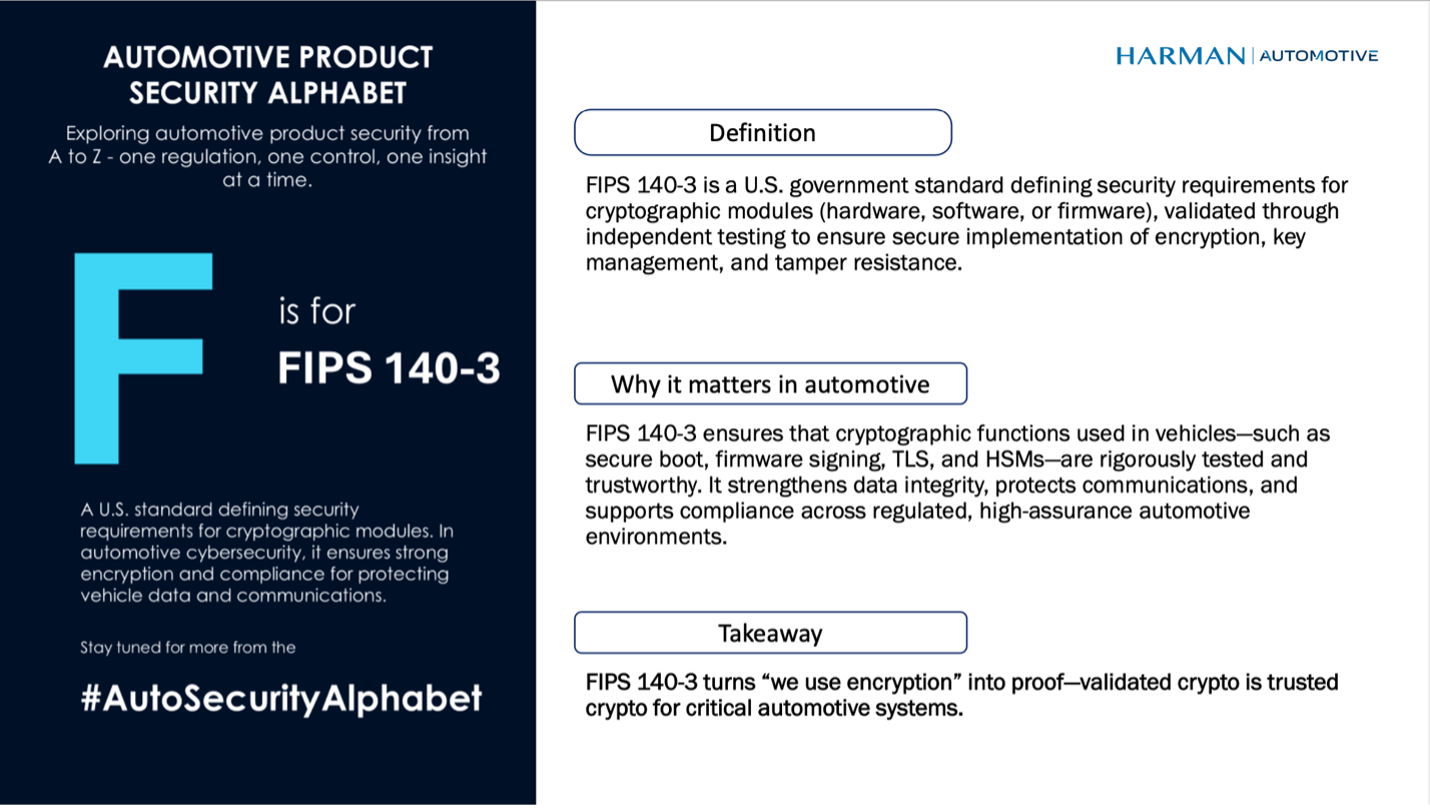
One speaker from HARMAN Automotive, Pawel Brzezinski, captured it very well in his talk titled “Automotive Product Security Alphabet”, where F is for FIPS 140-3.
Cryptographic Assurance as a Foundation for Future Automotive Security
The discussions throughout ESCAR USA reinforced an important reality for the automotive cybersecurity community: modern vehicle security increasingly depends not only on identifying vulnerabilities, but also on systematically establishing trust in the cryptographic foundations that support secure communication, authentication, software integrity, and long-term operational resilience.
As automotive systems continue evolving toward software-defined architectures and continuously connected services, cryptographic assurance will become increasingly important. Independent validation, entropy assessment, secure key lifecycle management, and implementation assurance can help reduce systemic risk across modern automotive ecosystems.
For atsec, this aligns closely with our broader mission of helping industries apply practical cryptographic assurance practices to real-world, security-critical environments. The growing intersection between automotive cybersecurity, embedded systems assurance, hardware security, and cryptographic validation creates important opportunities for collaboration across industry and academia.
These topics will continue to be explored at the upcoming FIPS ‘n’ Chips event this October, co-hosted by atsec and The University of Texas at Austin. The event brings together experts from government, industry, academia, and accredited laboratories to discuss the future of cryptographic technologies, validation programs, hardware security, post-quantum cryptography, and applied assurance engineering.
Given the strong technical discussions and collaborative spirit demonstrated throughout ESCAR USA, we would like to cordially invite ESCAR attendees, automotive cybersecurity researchers, OEMs, suppliers, and embedded security engineers to join us at FIPS ‘n’ Chips and continue these important conversations on the future of cryptographic assurance and secure automotive systems.